
Understanding Turbidity Curtains: The Basics
Turbidity curtains (also known as silt curtains or silt barriers) are floating barriers designed to contain suspended sediments and prevent them from spreading throughout a water body. They typically consist of a permeable or impermeable fabric skirt suspended from a flotation boom, with a ballast chain at the bottom to keep them taut.
The key to choosing the right curtain lies in understanding the water conditions and the project’s specific needs.
The Different “Types” of Turbidity Curtains
The industry generally categorizes turbidity curtains into three main types, based on their design and ability to withstand different water conditions:
1. Type 1 Turbidity Curtains: Your Go-To for Calm Water
When people ask, “What type of turbidity curtain for calm water?” – Type 1 is almost always the answer.
- Options: DOT or Contractor
- Design: Type 1 curtains are lighter-duty and designed for areas with minimal current or wave action. They typically feature a continuous top flotation boom, a robust fabric skirt (often PVC-coated polyester or polypropylene), and a ballast chain along the bottom. The sections are connected with easy-to-use universal slide connectors.
- Ideal Applications:
- Ponds and Lakes: Perfect for small-scale dredging, shoreline work, or pond maintenance where water movement is negligible.
- Protected Coves and Harbors: Areas sheltered from open water currents and heavy boat traffic.
- Retention Ponds: Effective for containing sediment during dewatering or construction activities.
- Small Canals: Where water flow is slow and controlled.
- Key Features: Lightweight, easy to deploy and retrieve, and cost-effective for calm environments. They are generally not reinforced for strong pulling forces.
-
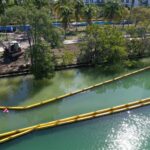
- type 1 turbidity curtain
-
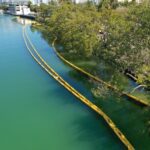
- type 1 turbidity curtain
-
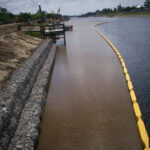
- type 1 turbidity curtain
-
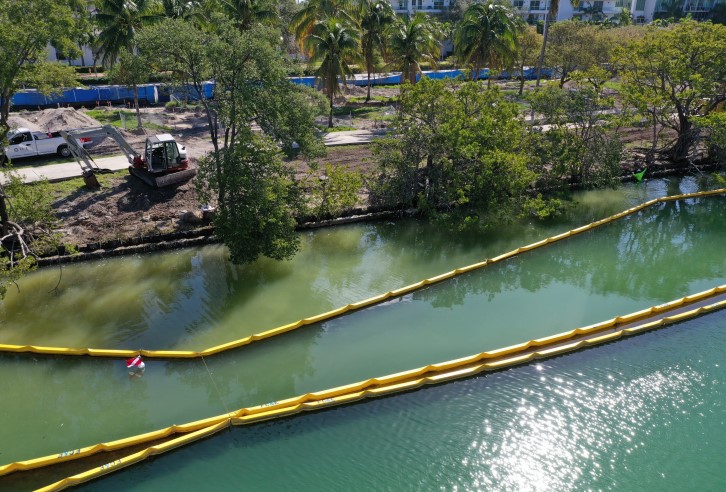
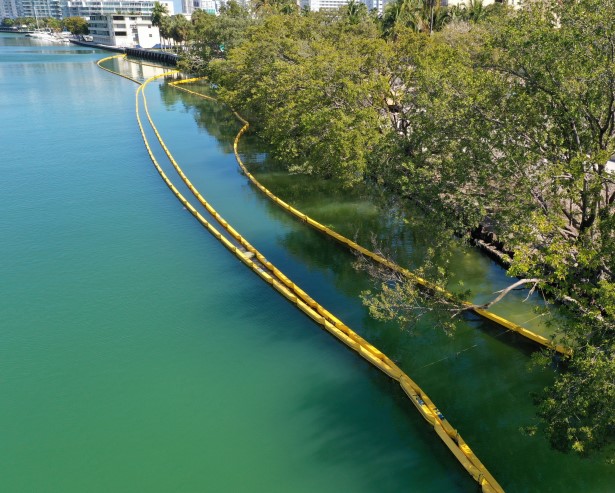
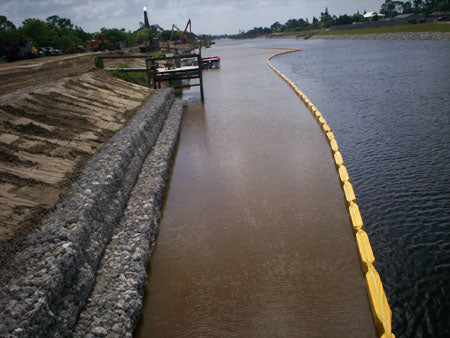
The difference between a DOT-compliant Type 1 curtain and a standard contractor-grade Type 1 curtain is primarily in the specifications of the materials and construction.
- DOT Type 1: Is the Heavy-Duty version. It is built to meet specific state Department of Transportation (DOT) standards, typically requiring thicker fabric (e.g., 18 oz. or more), larger flotation foam (e.g., 6″x6″), and a heavier ballast chain to ensure reliable and verifiable performance for regulated projects.
- Contractor Grade/Economy Type 1: Is a Lighter-Duty version. It uses thinner fabric, smaller floats, and lighter chain, making it a lower-cost alternative suitable for non-regulated, short-term, or private projects where only minimal turbidity control is needed.
In essence, the DOT curtain is built stronger to guarantee compliance and performance for public works projects, while the contractor curtain prioritizes low cost for simple, private jobs.
2. Type 2 Turbidity Curtains: For Moderate Conditions
While not specifically for “calm water,” it’s important to understand Type 2 for comparison, as projects can sometimes span areas with varying conditions.
- Options: DOT, HD or HD Permeable
- Design: Type 2 curtains are a step up in durability. They feature stronger flotation, heavier-duty fabric, and most importantly, tension cables running through the skirt. These cables absorb the stress from currents, preventing the fabric from tearing and ensuring the curtain maintains its integrity.
- Ideal Applications:
- Rivers and Streams: Where moderate currents (up to 1.5 knots) are present.
- Intracoastal Waterways: Areas with some tidal flow or boat traffic.
- Near Bridge Construction: Where some current is expected.
- Key Features: Reinforced with tension cables, more robust construction, and better suited for prolonged deployment in moderately dynamic environments.
-
- Type 2 Turbidity Curtain
-
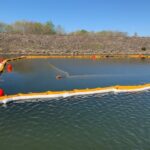
- Type 2 Turbidity Curtain
-
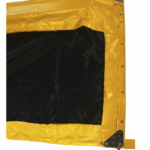
- Type 2 Turbidity Curtain Permeable
3. Type 3 Turbidity Curtains: For Demanding Environments
Again, not for calm water, but crucial for understanding the full spectrum of options.
- Options: HD Impermeable, DOT Permeable, HD Permeable
- Design: Type 3 curtains are the most robust, built to withstand significant currents (up to 3 knots), strong waves, and heavy tidal action. They feature oversized flotation, heavy-duty fabrics, multiple tension cables (often both top and bottom), and robust, reinforced end connections to handle extreme loads.
- Ideal Applications:
- Open Coastal Waters: Where wave action and strong currents are common.
- Major Shipping Channels: To withstand vessel wakes and strong tides.
- Large-Scale Dredging Operations: In high-energy environments.
- Key Features: Maximum durability and strength, designed for the harshest marine conditions. These require significant anchoring and careful deployment.