How to Determine if You Should Remove a Turbidity Curtain Prior to a Storm and Why?
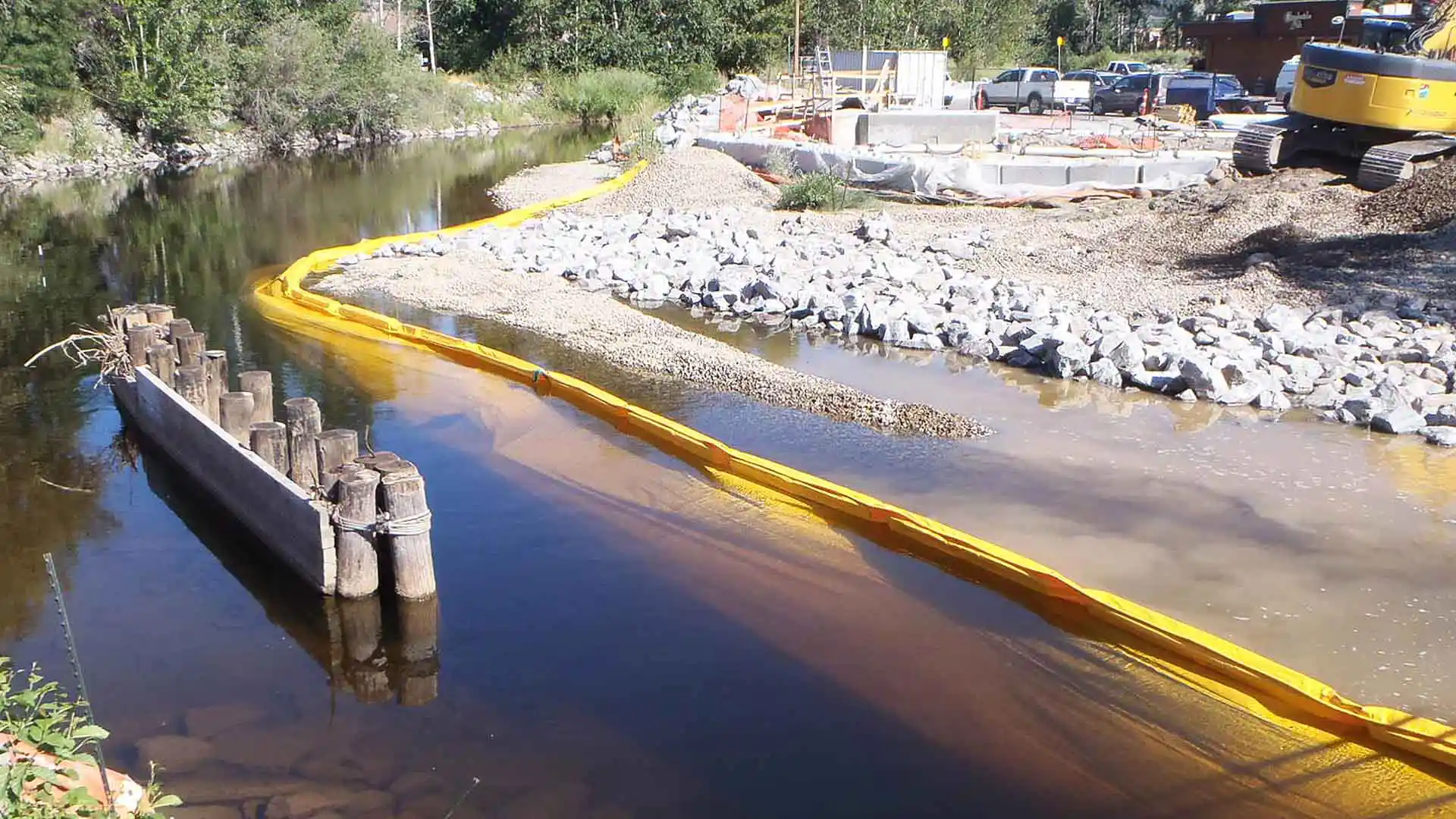
When severe weather is approaching a marine construction or dredging site, one important question is whether a turbidity curtain should be removed before the storm or left in place. High winds, waves, currents, storm surge and floating debris can place significant loads on a curtain system, potentially damaging the barrier, anchors and nearby structures. At the same time, removing a turbidity curtain too early, or without considering permit requirements and sediment conditions, can create environmental and compliance risks.
The right decision depends on the storm forecast, site exposure, curtain design, anchor capacity, sediment-control requirements and whether the system can be safely retrieved before conditions deteriorate. Evaluating these factors early gives project teams time to protect workers, equipment and surrounding waterways while maintaining effective sediment control.
Determining Whether the Curtain Should be Removed
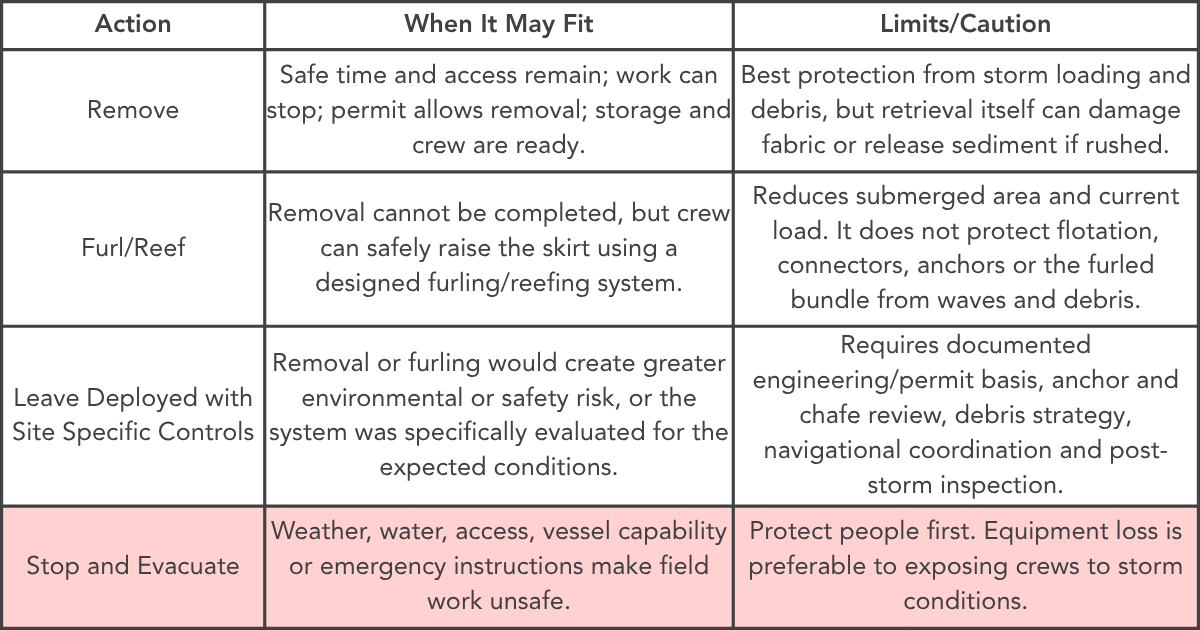
Removal is generally favored when the curtain can be retrieved and stored before the site becomes unsafe, the permit allows temporary removal, and the work can be paused without creating uncontrolled sediment discharge. The decision should be made early enough to allow settling, furling, disconnection and transport in daylight and acceptable marine conditions.
Removal becomes more difficult when the curtain is near large debris sources, beside structures that can crush or abrade it, attached to anchors of uncertain capacity, already damaged, heavily fouled, difficult to access after flooding, or likely to obstruct emergency navigation.
Leaving a curtain in place may be considered when removal would violate a permit or release contaminated sediment, if the site is protected, when the system was specifically engineered for the forecast load case, or when safe retrieval cannot be completed before conditions deteriorate. That is not the same as doing nothing. The project team should document why removal was rejected, what risk-reduction steps were taken and who approved the plan.
Temporary Removal Procedure
Use the manufacturer’s instructions and the project-specific lift plan. The sequence below is a planning framework, not a substitute for the actual procedure.
1. Stop sediment-disturbing work and allow suspended material to settle as required by the permit, inspector or engineer.
2. Confirm weather, daylight, marine access, crew roles, communications, personal flotation devices, lifting capacity and stop-work limits.
3. Remove floating debris around the curtain only when it can be done safely without loading or puncturing the barrier.
4. Raise or furl the skirt while it is supported in the water, using installed reefing/furling lines or an approved method. Avoid loose loops that can entangle personnel, wildlife, propellers or hardware.
5. Disconnect sections in a controlled sequence. Support the weight of chain and wet fabric so connectors and grommets are not used as lifting points unless designed for that purpose.
6. Use a compatible tow bridle to distribute towing load. Tow slowly and prevent the curtain from twisting, dragging on bottom or contacting propellers, pilings and sharp structures.
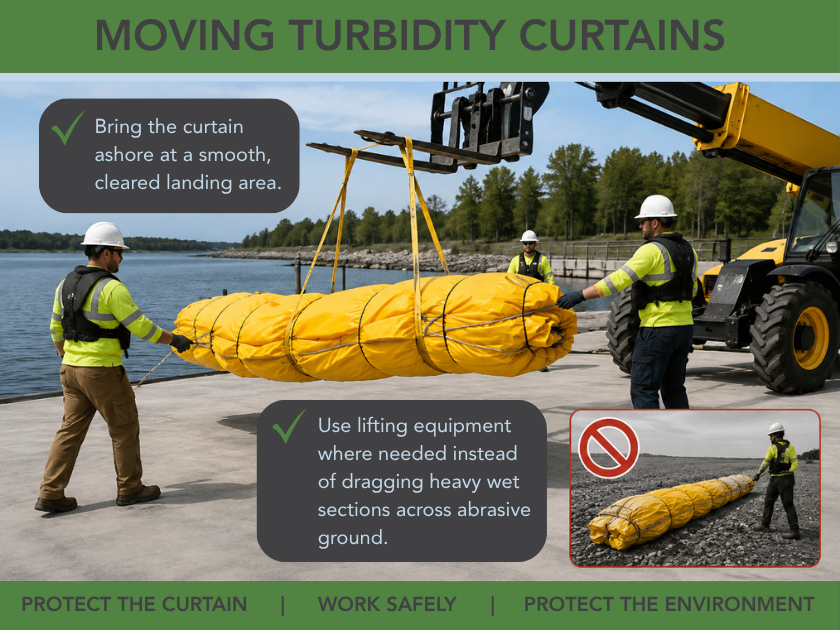
7. Bring the curtain ashore at a smooth, cleared landing area. Use lifting equipment where needed instead of dragging heavy wet sections across abrasive ground.
8. Rinse with appropriate clean water where permitted, remove debris and marine growth, and inspect each section before packing.
9. Tag sections and damaged locations. Keep pins, shackles, bridles, marker lights and anchor components organized by system.
10. Store above flood level, away from chemicals, heat, sharp edges, rodents and vehicle traffic. Support the curtain so chain and hardware do not crush flotation or fabric.
Safe Storage Recommendations
A curtain can survive removal and still be ruined in storage. Wet fabric folded around sharp hardware develops punctures and abrasion. Mud, salt and organic material hold moisture against metal and make later inspection difficult. Heavy ballast chains can crush foam or create a permanent crease when sections are stacked carelessly.
• Choose high ground outside the expected flood, surge and drainage path.
• Use pallets, cradles or dunnage that distribute weight with no exposed nails, splinters or sharp corners.
• Separate or pad connectors, chains, anchors and other metal components from fabric and flotation.
• Allow the curtain to drain and dry as far as practical before long-term packing.
• Do not pressure-wash at a setting that damages coatings, seams or fabric.
• Label each section with length, depth, configuration, condition and repair status.
• Protect from direct long-term UV exposure while maintaining ventilation.
• Store repair kits, pins, shackles, marker lights and batteries in a separate inventory container.
Ultimately, deciding whether to remove a turbidity curtain prior to a storm requires balancing worker safety, environmental protection, regulatory requirements and the ability of the installed system to withstand the expected conditions. If temporary removal is the safest option, a planned retrieval, inspection and storage process can help prevent avoidable damage and make reinstallation easier once conditions improve. If the curtain must remain in place, the project team should verify its condition, anchoring and storm readiness and document the reasoning behind the decision. By incorporating turbidity curtain storm preparation into the project’s severe-weather plan, contractors can reduce equipment losses, minimize uncontrolled sediment releases and return to work more efficiently after the storm passes.